
- Buy Crypto
- Markets
- Futures
- Spot
- Copy Trade
 Earn
Earn- More
Talus Network: The Infrastructure Innovator Toward the "Full On-Chain AI Agent Era"

Source: Talus Community Enthusiast
01 Project Positioning: Filling the Decentralized AI Infrastructure Gap
Currently, most "AI+Crypto" projects adopt an "off-chain computation, on-chain settlement" model. While this model achieves high computational efficiency, the AI decision-making process itself is a "black box," and external parties cannot verify whether it follows preset rules.
The "fully on-chain" approach proposed by the Talus Network is completely different. It aims to have the logic, state, and decision steps of AI agents all be part of smart contracts, directly executed and recorded on the blockchain.
This architecture brings a revolutionary advantage in verifiability. Due to the public transparency and tamper-resistant nature of the blockchain, anyone can audit the full history of AI agent behavior and decision-making basis, thereby establishing "mathematical trust" that does not rely on third-party operators.
02 Technical Architecture: Multi-Layer Component Collaboration Engineering
The Talus tech stack consists of multiple collaborating components, together forming an efficient and secure decentralized AI agent platform.
Foundational Infrastructure
At the core of Talus is a proof-of-stake blockchain node based on the Cosmos SDK and CometBFT, called the Protochain Node. This choice provides flexibility, robustness, and high performance, laying a solid foundation for the operation of smart agents.
On the smart contract layer, Talus adopts Sui Move as the smart contract language. The Move language is renowned for its high performance, security, and programmatic properties, enhancing the security of on-chain logic and simplifying the creation, transfer, and management of digital assets.
Cross-Chain and Off-Chain Resource Integration
Talus also introduces the IBC inter-blockchain communication protocol, achieving seamless interoperability between different blockchains, allowing smart agents to interact across multiple blockchains and utilize data or assets.
Facing the high computational requirements of AI processes and the gap with the blockchain environment, Talus introduces the concept of mirrored objects to represent and validate off-chain resources on-chain, such as models, data, and computation objects, ensuring the uniqueness and tradability of resources.
Smart Agent Core Features
Through the Talus AI technology stack, developers can create intelligent agents with four key characteristics:
Autonomy: Can operate without constant human guidance, making decisions based on its programming and learning
Social Ability: Can communicate with other agents (including humans) to accomplish tasks
Reactiveness: Can perceive the environment and respond promptly to changes
Proactiveness: Can take proactive actions based on goals and predictions
03 Ecosystem Progress: Testnet Launch and Early Application Deployment
The development of the Talus Network has entered a substantive stage. In September of this year, Talus launched its public testnet and introduced its first application, idol.fun, a platform that allows users to interact with decentralized virtual idols.
This application serves a dual purpose: on one hand, it is a proof of concept that intuitively showcases the functionality of "on-chain AI agents"; on the other hand, it serves as network guidance to attract early users for testing, accumulating initial transaction activity and community foundation for the network.
In terms of funding, Talus Network completed a $3 million seed round led by Polychain Capital in February 2024, followed by a $6 million strategic round at a $150 million valuation in November, with participation from several well-known investment institutions.
The project team is led by CEO Mike Hanono and COO Ben Frigon, both of whom have extensive experience in the blockchain and AI fields.
04 Challenges and Prospects: Key Tests on the Path to Commercialization
Despite its grand technological vision, the Talus Network still faces three major challenges on the path to commercialization.
Technical Feasibility and Cost Efficiency
The biggest obstacle faced by "on-chain AI" is how to reduce computing costs to a commercially acceptable range while ensuring decentralization and verifiability.
Even on a high-performance public chain like Sui, the operating costs of complex AI agents may be far higher than off-chain solutions, severely limiting their application scenarios.
Market Competition and Differentiation
The field of "decentralized AI agents" is not a completely new concept. Projects such as Fetch.ai and Olas (Autonolas) already exist in the market. They mostly adopt a hybrid model of "off-chain computation + on-chain coordination/settlement," which provides advantages in performance and cost.
Talus must prove, in specific scenarios, that its "trust advantage" is sufficient to offset its disadvantages in performance and cost on a "fully on-chain" path.
Value Capture and Ecosystem Development
The ef="/wiki/article/token-259">token of Talus will be used for network governance, paying for agent execution tasks, etc. The effectiveness of its value capture depends directly on whether it can successfully incentivize a large and active developer and AI agent ecosystem.
In the early stages of the project, designing effective incentive mechanisms to guide the formation of network effects will be a key test for its tokenomics model.
Currently, the Talus testnet activities have attracted over 35,000 participants, and its airdrop plan is also underway.
Industry observers are closely watching whether Talus can find a balance between technical idealism and business viability, thus truly ushering in a new era of decentralized AI agents.
This article is contributed content and does not represent the views of BlockBeats.
You may also like

After Forty Years of Sanctions, How Iran Is Rebooting Financial Channels Through Crypto

Telegram 2025 Financial Report Puzzle: Revenue Soars by 65%, Yet Plagued by $200 Million Loss Due to TON?

Crypto and AI: the hidden digital gray market of Xianyu
Crypto and AI: You Can Buy Anything on Xianyu.

What’s Driving Crypto Markets in Early 2026: Market Swings, AI Trading, and ETF Flows?
Imagine checking Bitcoin and Ethereum prices in a day — one minute up 5%, the next down 4%. Sharp moves, quick reversals, and sensitivity to macro signals marked the first week of 2026. After an early-year rally, both assets pulled back as markets recalibrated expectations around U.S. monetary policy and institutional flows. For traders — including those relying on AI or automated systems — this period offered a vivid reminder: abundant signals do not guarantee clarity. Staying disciplined in execution is often the real challenge.
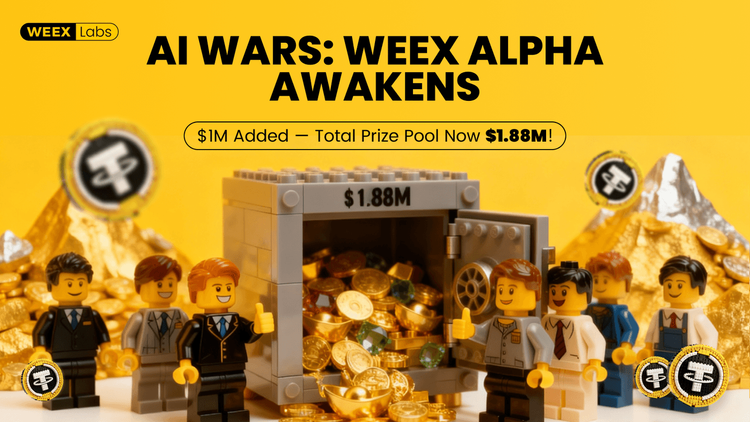
WEEX Global AI Trading Hackathon Kicks Off: $1.88M Prize Pool Powers the Next Generation of AI Trading Champions
WEEX Labs, the innovation arm of WEEX, a leading global crypto exchange serving over 6.2 million users across 150+ countries, is set to kick off the preliminary round of its flagship global AI trading hackathon, AI Wars: WEEX Alpha Awakens, on January 12, 2026. Backed by the strong support of world-class sponsors including Amazon Web Services (AWS), the total prize pool has surged from $880,000 to an unprecedented $1,880,000, positioning AI Wars among the largest AI trading hackathons in the crypto industry. At the top of the leaderboard awaits an extraordinary champion prize — a Bentley Bentayga S, already on standby in Dubai, ready to be claimed by the ultimate AI trading victor.

December Exchange Rankings: CEX and DEX Simultaneously Weaken, On-Chain Perpetual Contract Trading Volume Declines by 30%

2025 Market Prediction Retrospective: Total Transaction Volume Exceeds $50 Billion, Duopoly Market Share Exceeds 97.5%

Key Market Info Discrepancy on January 9th - A Must-Read! | Alpha Morning Report
Binance Launches Regulated Gold and Silver Perpetual Futures Settled in USDT
Key Takeaways: Binance has introduced its first regulated perpetual futures contracts, which are tied to traditional assets like…

Vietnam Sets Mid-January Timeline for Pilot Crypto Exchange Approvals
Key Takeaways Vietnam aims to regulate its growing cryptocurrency market by licensing pilot digital asset exchanges under a…

Pentagon Pizza Index Soars 1250%: Who Will Be the Next Venezuela?

From Theory to Live Markets: AOT Matrix’s Dual-Brain System in WEEX AI Trading Hackathon
In crypto markets — one of the most unforgiving non-stationary systems — strategy failure is rarely caused by models being too simple. It happens because most strategies are never truly exposed to live-market pressure. This is exactly the problem WEEX AI Trading Hackathon is designed to surface — shifting the focus from theoretical innovation to real deployability, real execution, and real performance. Among the participating teams, AOT Matrix stood out with advanced AI-driven quantitative capabilities. Through its V4.4 dual-brain architecture, the system achieved end-to-end optimization — from core logic to execution — reflecting the platform’s dual emphasis on innovation and real-world performance.

Predicting Contrarian Buy Pressure in the Market: Who is Taking the Other Side of Your Trade?

The old altcoin script is outdated, take you to decipher the new market structure

$250 Billion, 6723 Rounds of Funding: Where Did Crypto VCs Invest in 2025?

Visa Crypto Lead: Eight Key Evolutions of Crypto and AI by 2026

Rumble Launches Crypto Wallet in Collaboration with Tether, Boosting Share Value
Key Takeaways: Rumble’s latest innovation integrates cryptocurrency tipping for content creators directly within its platform. Built in partnership…

Former Brazil Central Bank Official Introduces Real-Pegged Stablecoin Offering Yield Sharing
Key Takeaways BRD, a newly unveiled stablecoin by Tony Volpon, a former director of the Central Bank of…
After Forty Years of Sanctions, How Iran Is Rebooting Financial Channels Through Crypto
Telegram 2025 Financial Report Puzzle: Revenue Soars by 65%, Yet Plagued by $200 Million Loss Due to TON?
Crypto and AI: the hidden digital gray market of Xianyu
Crypto and AI: You Can Buy Anything on Xianyu.
What’s Driving Crypto Markets in Early 2026: Market Swings, AI Trading, and ETF Flows?
Imagine checking Bitcoin and Ethereum prices in a day — one minute up 5%, the next down 4%. Sharp moves, quick reversals, and sensitivity to macro signals marked the first week of 2026. After an early-year rally, both assets pulled back as markets recalibrated expectations around U.S. monetary policy and institutional flows. For traders — including those relying on AI or automated systems — this period offered a vivid reminder: abundant signals do not guarantee clarity. Staying disciplined in execution is often the real challenge.
WEEX Global AI Trading Hackathon Kicks Off: $1.88M Prize Pool Powers the Next Generation of AI Trading Champions
WEEX Labs, the innovation arm of WEEX, a leading global crypto exchange serving over 6.2 million users across 150+ countries, is set to kick off the preliminary round of its flagship global AI trading hackathon, AI Wars: WEEX Alpha Awakens, on January 12, 2026. Backed by the strong support of world-class sponsors including Amazon Web Services (AWS), the total prize pool has surged from $880,000 to an unprecedented $1,880,000, positioning AI Wars among the largest AI trading hackathons in the crypto industry. At the top of the leaderboard awaits an extraordinary champion prize — a Bentley Bentayga S, already on standby in Dubai, ready to be claimed by the ultimate AI trading victor.


 App
App