


WEEX's Ranking and Liquidity Score: What Nearly a Decade of Market Cycles Actually Reveals
Crypto never runs short on stories. Over the past eight years, the market has swung from euphoric rallies to deep drawdowns, watched thousands of projects launch and just as many disappear, and moved from the retail driven frenzy of 2017 to the industry wide shakeout of 2022 to the institutional capital that's flowed in over the past two years. Against that backdrop, looking at which trading platforms are still standing tells you something a single ranking snapshot can't.
WEEX entered the market in 2018, a year that offered the crypto industry no easy path. Bitcoin had pulled back sharply from the prior bull run, sentiment had cooled fast, and a large number of projects and platforms faced a genuinely difficult test. Unlike the platforms that spring up during a bull market, a platform launching into a bear market has to answer more grounded questions from day one: how to survive, how to earn user trust, and how to keep operating without the tailwind of a rising market carrying it forward.
Why surviving multiple market cycles is a more meaningful signal than any single ranking
Looking back from today, almost no one at the time could have predicted how the industry would actually unfold. The crypto trading market was still in a fast growth phase, and platforms mostly competed on trading volume growth and user expansion speed. For a lot of users, exchange rankings functioned as the main proxy for judging a platform's strength.
A ranking captured at a single point in time only tells you where a platform stood on that specific day, under that specific market condition. What it doesn't tell you is whether the platform can keep operating once the market turns, once user growth slows, or once a wave of industry wide scrutiny arrives. That's a different, and arguably more useful, question, and it can only be answered by looking at a platform's trajectory across multiple cycles rather than a single reading.
What WEEX's early ranking and liquidity score looked like
A few years back, an industry observation piece noted that WEEX had entered the top tier of CoinMarketCap's global derivatives exchange rankings, while also holding a relatively high position on the spot exchange leaderboard. More telling than the ranking position itself was the platform's liquidity score at the time, which stood above 700. For professional traders, a liquidity score in that range signals meaningful order book depth and the ability to absorb trade flow without excessive slippage, which matters more in practice than where a platform sits in a ranked list.
That period, 2020 through 2021, went on to become one of the most representative growth cycles the industry has seen. The DeFi boom took off, the NFT market exploded, and Bitcoin and Ethereum repeatedly set new highs as a wave of new users entered the market. Trading platforms had an unprecedented growth opportunity in front of them, but that same rapid expansion raised the bar sharply on system stability, liquidity infrastructure, and risk control. Plenty of platforms picked up attention during the bull run without ever building out the underlying capability to sustain it, while others began shifting their competitive focus away from pure scale and toward infrastructure and trading experience.
What the 2022 downturn actually tested
The market didn't stay forgiving for long. 2022 brought one of the sharpest trust resets the industry has experienced in recent years. Project collapses, institutional crises, and a string of exchange level risk events in quick succession pushed users to reconsider a question that had gone largely unexamined: what does a trading platform's long-term operation actually depend on?
The answer clearly wasn't trading volume alone. Liquidity quality, risk control systems, fund security mechanisms, technical stability, and long-term service capability gradually became the factors users weighed more heavily when choosing a platform, and industry competition shifted from a race for growth speed to a test of staying power. In that shakeout, a number of once-prominent platforms faded from the market, while platforms that stuck with long-term operations moved into a new phase of development.
Where WEEX's ranking and liquidity stand in 2026
Looking at WEEX's trajectory again in 2026, what the market pays attention to has clearly changed. Where ranking position drew most of the outside attention a few years ago, more and more traders today are focused on metrics closer to actual trading experience, liquidity, depth, and order execution quality among them.
According to CoinMarketCap data as of August 27, 2026, WEEX's spot exchange ranking now sits at 34th globally, while its derivatives exchange ranking has held within the top tier. At the same time, its liquidity score has climbed from roughly 716 in the earlier period to 798 today.
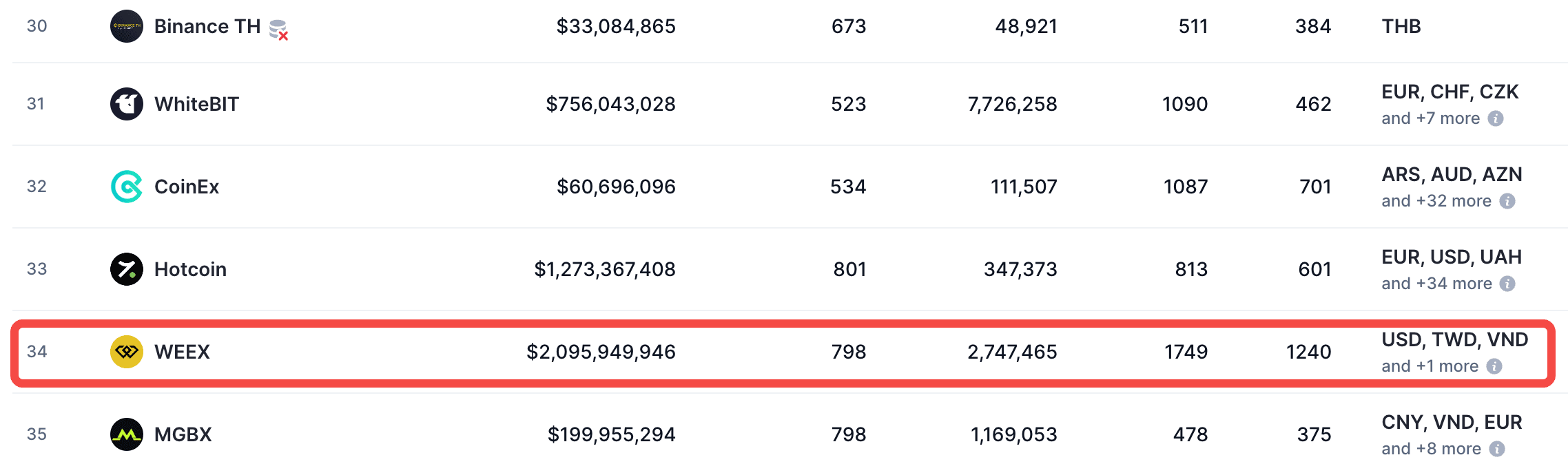
Data and screenshot sourced from CoinMarketCap (coinmarketcap.com), as of August 27, 2026.
Why liquidity score matters more than the ranking number itself
For a trading platform, liquidity level connects directly to order execution efficiency, bid-ask depth, and the trading experience during periods of market volatility. When a user is executing a large trade, whether the platform can keep slippage low and maintain market depth carries more practical weight than where it sits on a ranked list. A ranking can shift for reasons unrelated to a platform's actual trading infrastructure. A liquidity score climbing steadily over a multi-year span, across more than one market cycle, is harder to produce without the underlying order book depth and execution capability actually being there.
At the same time, as the global digital asset market matures, the basis of competition between platforms is shifting too. The growth playbook built around marketing spend and user acquisition volume is being redefined, and a platform's overall service capability, product stability, and global operating footprint are becoming the new focal points of competition.
What cycle survival signals that a single snapshot can't
From 2018 to 2026, the crypto industry has moved through several full cycles. Market conditions have shifted repeatedly, and participants have turned over just as often, but platforms that manage to stay standing across multiple bull and bear cycles remain the exception rather than the rule. For any exchange, a single ranking move up or down is often just a snapshot of one moment. What actually requires time to verify is whether a platform can keep delivering stable service, keep improving its trading infrastructure, and keep operating over the long run.
As the industry moves from rapid growth toward maturity, the platforms that have weathered multiple market cycles are being evaluated against a different standard than the one that mattered in 2018 or 2021, and it's one that rewards duration and consistency over any single point-in-time result.
Conclusion
WEEX's path from a 2018 bear market launch to its 2026 position, spot ranking near 36th globally on CoinMarketCap, a derivatives ranking that has held within the top tier, and a liquidity score that's climbed from roughly 716 to 798, reflects more than incremental growth. It reflects a platform that kept operating through the 2020-2021 growth cycle, the 2022 trust crisis, and the subsequent shift toward infrastructure driven competition, rather than one that peaked during a single favorable market window. For anyone evaluating an exchange today, that multi-cycle track record is a more meaningful reference point than any single ranking snapshot.
FAQ
1. When was WEEX founded and what market conditions did it launch into?
WEEX was founded in 2018, a year when Bitcoin had pulled back sharply from the prior bull run and the broader crypto market was in a difficult, low sentiment stretch, requiring platforms launching at that time to focus on survival and trust building rather than riding a market tailwind.
2. Where does WEEX rank on CoinMarketCap in 2026?
According to publicly available data, WEEX's spot exchange ranking sits at roughly 34th globally on CoinMarketCap, while its derivatives exchange ranking has held within the top tier.
3. How has WEEX's liquidity score changed over time?
WEEX's liquidity score has risen from roughly 716 in an earlier period to 798 today, reflecting improved order book depth and trade execution capability rather than just a ranking position shifting.
4. Why does liquidity score matter more than exchange ranking alone?
Liquidity level directly affects order execution efficiency, bid-ask depth, and slippage during large trades or volatile periods, which is a more practical measure of trading experience than a platform's position on a ranked list.
5. What did the 2022 market downturn change about how users evaluate exchanges?
The 2022 downturn, marked by project collapses and exchange level risk events, shifted user attention toward liquidity quality, risk control systems, fund security mechanisms, and long-term service capability, rather than trading volume or growth speed alone.

Gainers


